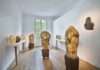
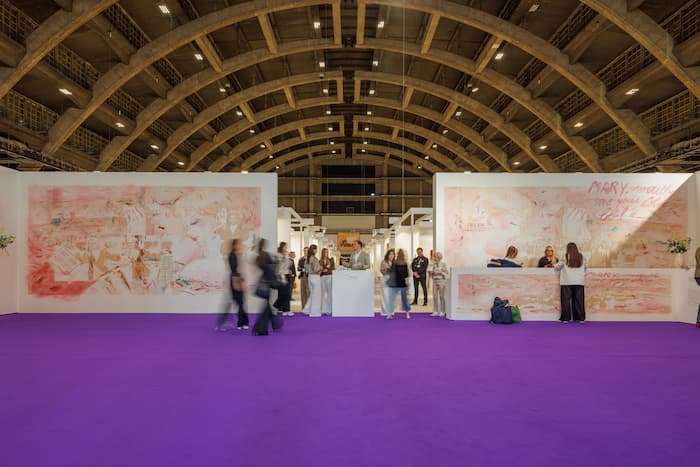
Installation view Natasja Mabesoone, Art Brussels 2026 courtesy de l’artiste et Sofie Van de Velde gallery Cc. Martin Pilette for Bureau Rouge
Under the sun, art blossoms in Brussels around this 42nd edition of the fair, staying true to its cosmopolitan regionalism. A scaled-down edition, certainly, with 139 galleries, even though Art Brussels radiates across an entire ecosystem, something Nele Verhaeren advocates with talent in both Brussels and Antwerp. Everything is designed to make the visitor experience engaging within the sumptuous Art Deco Hall 5, a refreshing contrast to the usual dehumanized mainstream formats and collectors are asking for more. The exhibition “Not Everything Is For Sale”, curated by Bernard Marcelis, is a gem, bringing together pivotal works in the journeys of 15 gallerists from the Belgian scene. Among them, Greta Meert selected a Jeff Wall piece featuring his son, Almine Rech chose a calligraphy by Mai-Thu, and Daniel Templon presented a photograph of Léo Castelli by Warhol. Art Brussels continues to activate the city through a range of parallel exhibitions and off-site projects, reinforcing its role as a platform embedded in the local and international scene. A forward-looking perspective I often reflect on in my columns.
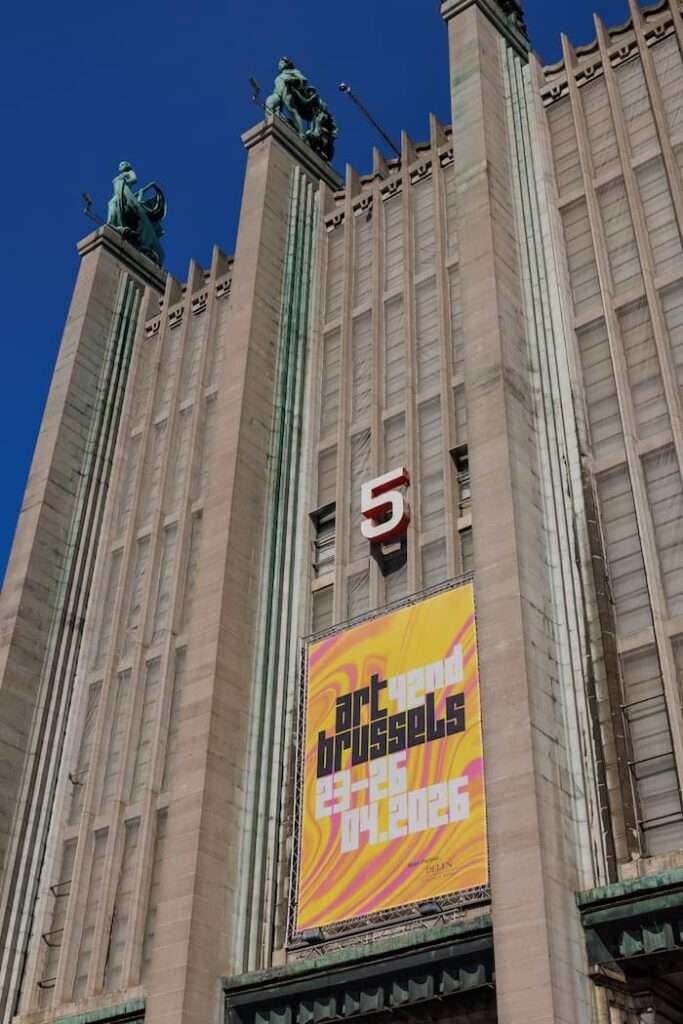
Art Brussels 2026, Brussels Expo Cc. Martin Pilette for Bureau Rouge
Opening focus on… Natasja Mabesoone: Sofie Van de Velde (Antwerp)
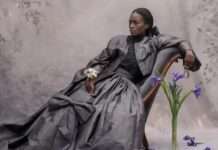
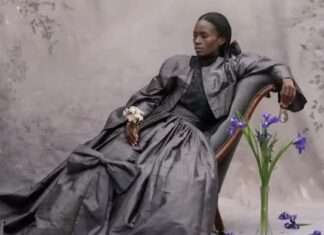
Commissioned by the fair, the artist transforms the entrance vestibule of Hall 5 into an immersive installation. In Cher mouths Mary, Mary mouths Cher (2026) draws on feminist art history, mythology, and pop culture. The work brings together references such as Mary Cassatt and the character of Cher Horowitz, the frivolous teenager from the film Clueless (1995).
Working across drawing, screen printing, collage, soft-ground etching, and makeup, the Belgian artist constructs a narrative around femininity and its instrumentalization, drawing on both literary and more popular references.
Between the ticketing areas, information desks, and circulation spaces, we witness a mise en abyme centered on the notion of the mirror. One small drawback: the all-over tarpaulin, which doesn’t fully allow the textures and material effects to be experienced.
Natasja has completed a residency at WIELS and is part of the artist collective Level Five, based in both Molenbeek and Forest. One to watch.
Elen Braga: Wouters Gallery (Brussels)
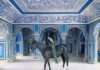
Within the new Horizons section, led by Devrim Bayar—whom I interviewed—a significant number of women artists are being highlighted on a large scale, which is a welcome development. In this monumental hand-tufted tapestry titled “Elen or Hubris”—referring to excess or pride—the artist stages herself wearing a work overall, in a posture that is both heroic and ironic, reactivating power dynamics and their representation.
On the occasion of International Women’s Day, the work was briefly installed beneath the Arc du Cinquantenaire in Brussels, symbolically replacing the Belgian flag. To extend the experience, the gallery space in the new “trendy” Kanal district offers a dialogue between Elen Braga, Ryo Kinoshita, and Noemi Weber.
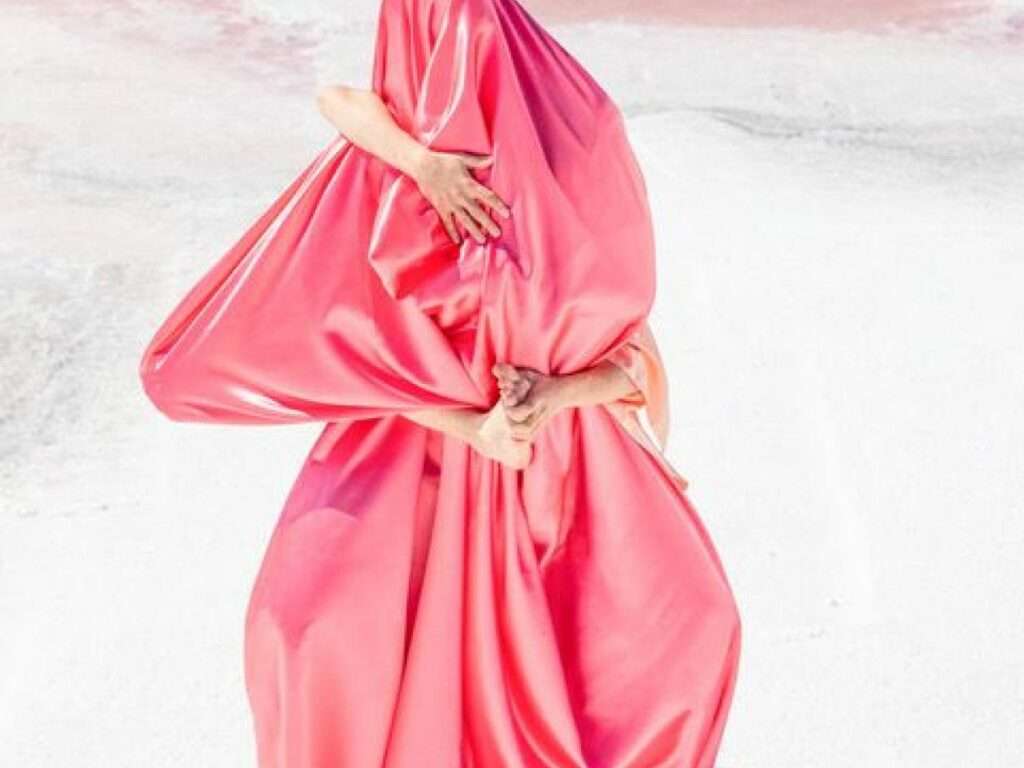
Klaatje Lambrechts, Shafagh courtesy the artist, Pedrami
Klaatje Lambrechts: Pedrami Gallery (Antwerp)
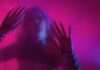
In light of current events, the focus turns to the Shafagh project by Belgian photographer Klaatje Lambrechts, emblematic of the gallery’s commitment to Middle Eastern scenes. The title means “twilight” in Persian, suggesting a dimension of the invisible and the forbidden. Originally a fashion photographer, she stages dancers whose bodies are wrapped and constrained by fabric, creating a form of invisibility that speaks to zones of tension in public space in Iran.
Her work stands out as an engaged practice rooted in specific geopolitical contexts, paired with a highly controlled aesthetic in the tradition of portraiture.
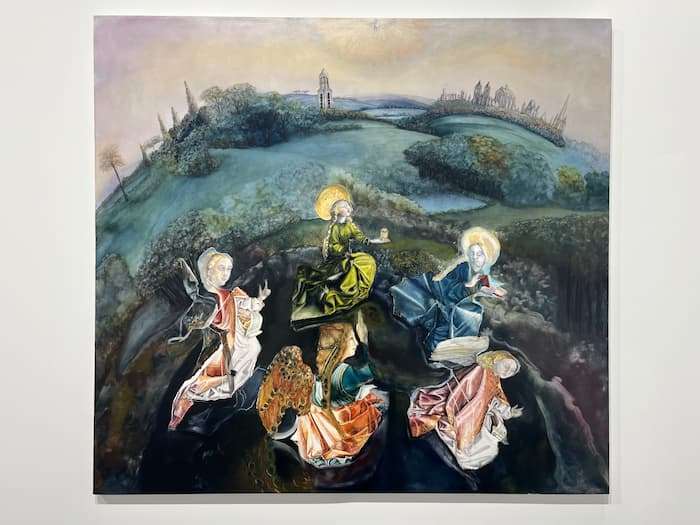
Emilie Terlinden, Mystical Danse, 2026 =courtesy the artist, Whitehouse Gallery
Stéphanie Baechler and Emilie Terlinden: Whitehouse Gallery (Brussels)
Swiss sculptor and designer Stéphanie Baechler, based in Amsterdam, situates her practice at the intersection of textile and ceramics, exploring the contradictory relationship between gesture and industrial production. The solo show brings together fragments from the installation Forget Me Not, originally presented at the Tröckneturm in St. Gallen (Switzerland), along with the tapestry Sybill III.
Alongside her is Emilie Terlinden, whom I recently interviewed on the occasion of her exhibition at Le Botanique as part of the Bicentenary of Photography. Her reinterpretation of Daguerre’s Diorama, conceived through a day-and-night dispositif, is striking. Timelapse is accompanied by the artist’s first monographic book.
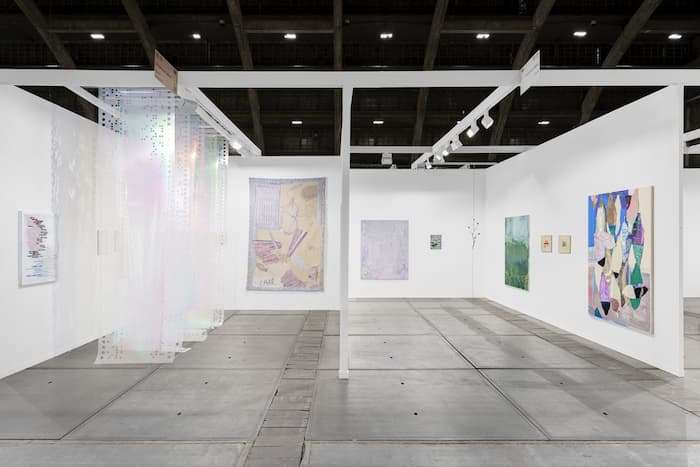
Whitehouse Gallery at Art Brussels 2026
Evelyn Nicodemus: Richard Saltoun Gallery (London)
The Tanzanian artist, based in Edinburgh, was introduced to the Belgian public last year by curator Sofia Dati at WIELS (read my interview with Sofia), in the context of her research on modern African art and her commitment to the emancipation of bodies and imaginaries. Trauma and healing are powerful driving forces in her work, evident in both her textile experiments and her drawings.
Nicola Tyson: Nino Mier (Brussels)
The installation of black-and-white drawings and sketchbooks forms true constellations, exploring notions of gender, sexuality, structures, and dominant forms of assignment. The British artist, based in New York and working in the wake of Hans Bellmer and Francis Bacon, uses flesh-toned hues charged with ambiguity to situate her atrophied and fragmented figures.
Andrew Robers : House of Chappaz (Barcelone)
Solo show, Discovery
The Mexican artist is engaged in a practice exploring the production of narrative systems in the globalized era, drawing on codes from video games—gameplay, quest-givers, and avatars. His work examines regimes of violence and domination, as well as the instrumentalization of cultural artifacts.
The multimedia installation “A Self Devouring Vortex” presents the vortex as an image of self-consuming capitalism, endlessly looping—a lure from which there is no escape. At the crossroads of magic and technology, his speculative, hybrid approach—almost playful on the surface—conceals a powerful undercurrent.
Prize Winners :
Discovery Acquisition Prize
This prize takes the form of an acquisition budget of up to €10,000, intended for the purchase of works for a museum collection, the Musée d’Ixelles.
This year’s jury was composed of:
Claire Leblanc, Director of the Musée d’Ixelles, Brussels
Horya Makhlouf, curator at Spacious Projects and artistic coordinator at the Palais de Tokyo, Paris
Gregory Thirion, Head of Exhibitions at Le Botanique, Brussels
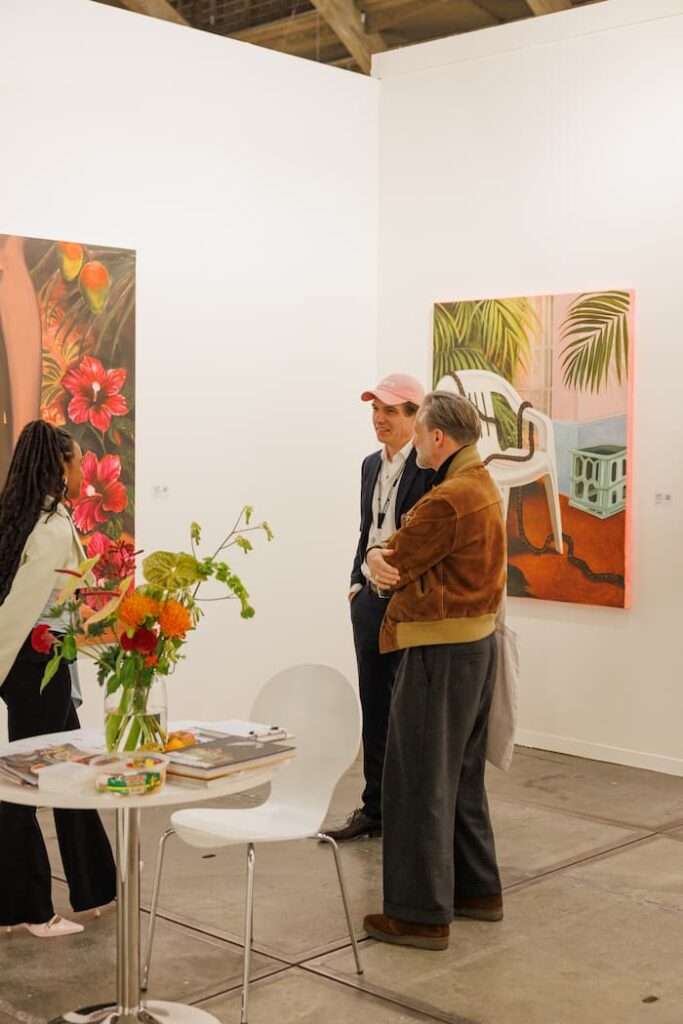
Tom Reichstein gallery at Art Brussels : Alejandra Caicedo Discovery Acquisition Prize Cc. Martin Pilette for Bureau Rouge
The three laureates are : Alejandra Caicedo, Lena Marie Emrich, and Kasper De Vos.
Alejandra Caicedo, represented by Tom Reichstein (Hamburg), is an Afro-Latina American artist who revisits the still life genre through the lens of her experience of displacement between Cali (her city of origin) and Hamburg (her adopted city). She emphasizes this in-between space through a sense of excess and unfulfilled idealized promises. Still life becomes an active metaphor in which fragmented, fluid bodies dissolve amid exotification and fantasies of abundance.
Lena Marie Emrich, represented by OFFICE IMPART (Berlin), is a sculptor who combines minimalism with everyday objects in a multidisciplinary approach. She was presented at the booth alongside Spanish artist Ana Maria Caballero, whose work around poetry particularly caught my attention.
Kasper De Vos, represented by Pizza Gallery (Antwerp/Ghent), is a Belgian sculptor who reinterprets the codes of folklore and popular culture through a surrealist lens.
’68 Forward Prize
This prize is awarded to the gallery presenting the best booth in the ’68 Forward section and grants the winning gallery a €5,000 endowment.
The prize goes to Einspach & Czapolai Fine Art, representing Orshi Drozdik, a Hungarian post-conceptual and feminist artist. Working across drawing, photography, engraving, installations, and performance, her practice questions perceptions of the woman artist and the stereotypes attached to her.
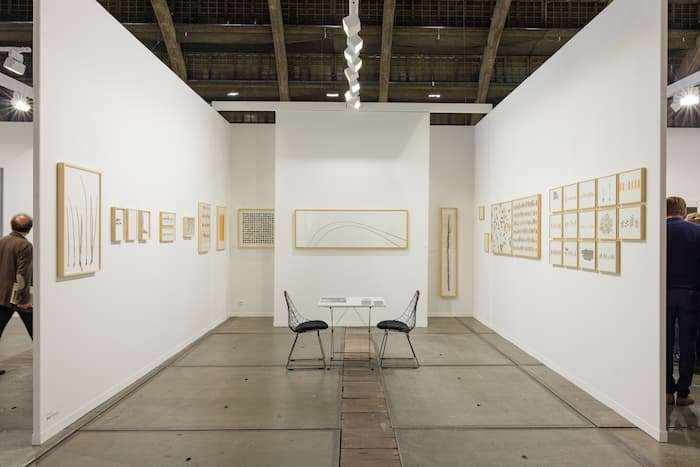
Settantotto at Art Brussels : herman de vries, SOLO PRIZE 2026 Cc. Martin Pilette for Bureau Rouge
Solo Prize
This prize carries a €15,000 endowment awarded directly to the artist.
It goes to the rather classic choice of Dutch artist herman de vries, represented by Settantotto (Ghent). His immediately recognizable approach—based on collected materials gathered during his travels and rubbing techniques—places living matter at the heart of his process.The space dedicated to concrete art in Mouans-Sartoux devoted a superb retrospective to his work.
It is worth noting that certain French galleries are absent this year despite having a presence in Brussels: Nathalie Obadia, Valérie Bach – La Patinoire Royale, and Michel Rein. On the Belgian side, Gauli Zitter, recently established in the capital and having taken part in Discovery, has launched a small alternative fair called Parloir in an abandoned building in the European Parliament district. The result is still quite embryonic, and galleries seem reluctant to engage, somewhat disappointing.
Next : Art Brussels in the city
Practical Information :
Art Brussels 2026
Until April, 26
Brussels Expo
Standard 20 euros
Youth 10 euros
In the City off program during the fair /
Organise your stay :
https://www.visit.brussels/fr/visiteurs