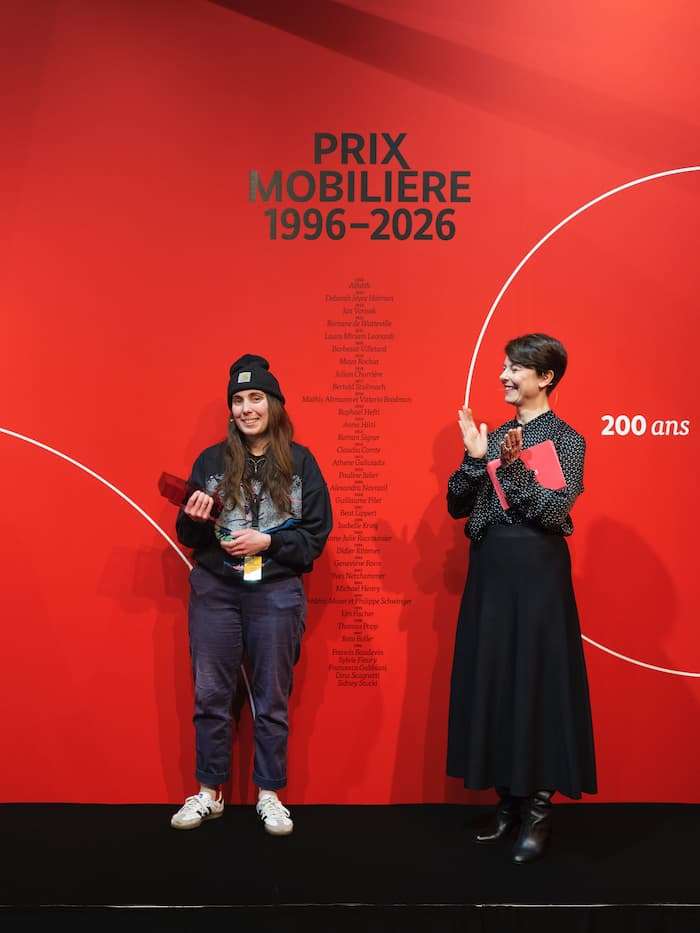
Cassidy Toner wins the Molière Prize 2026, Art Geneva 2026, Thomas Annaheim Lambert photography
The 14th edition of Art Genève sends out a structuring signal at the start of a chaotic year, underpinned by the stability and commitment of numerous Swiss institutions. Both international in scope (with 70% of galleries coming from abroad) and firmly rooted locally—marked by a growing presence from German-speaking Switzerland—the fair reflects the vision claimed by Charlotte Diwan, who spoke with me ahead of the opening. This year’s edition also stands out for the arrival of new galleries from Canada, Estonia, Austria, Korea…
Best Booths :
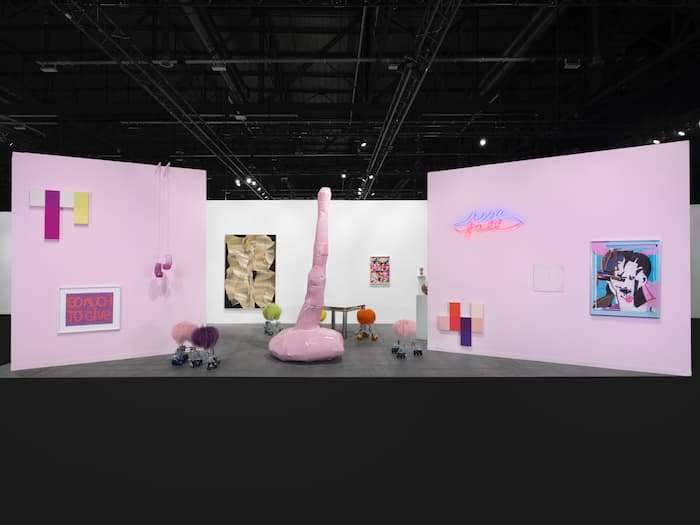
Xippas Booth, Art Genève 2026 Pic. Julien Gremaud
Xippas (Paris, Genève, Punta del Este)
Pink is the new color !
Alongside a majestic Franz West, a whole palette of pink unfolds— a colour long associated with baroque excess and playful frivolity. The stand embraces a joyfully chaotic atmosphere.
Béatrice Andrieux, the gallery’s director in Paris, presents the fur seatings by Marina Faust, an Austrian artist and long-standing photographic collaborator of fashion designer Martin Margiela.
Early in her career, Marina Faust expanded her practice beyond photography to include video, collage, and sculpture. Her work has been shown widely in museums across Europe, notably in France at Le Consortium in Dijon.
She was a close friend of Austrian artist Franz West, whose work is presented here alongside her Rolling Stools.
Wilde Gallery (Geneva) :
Valentin Carron and the 1980s Solex
My own madeleine de Proust of the fair: growing up outside the city, it was the sole means of emancipation : my ticket to the local PMU bar. A bygone era, before the distorting mirror of social media. The Swiss artist, who represented Switzerland at the Venice Biennale, is also featured on Eva Presenhuber’s superb stand, alongside the duo Fischli & Weiss.
Meanwhile, in the Quartier des Bains, Wilde is simultaneously presenting a solo exhibition by artist Cornelia Parker.
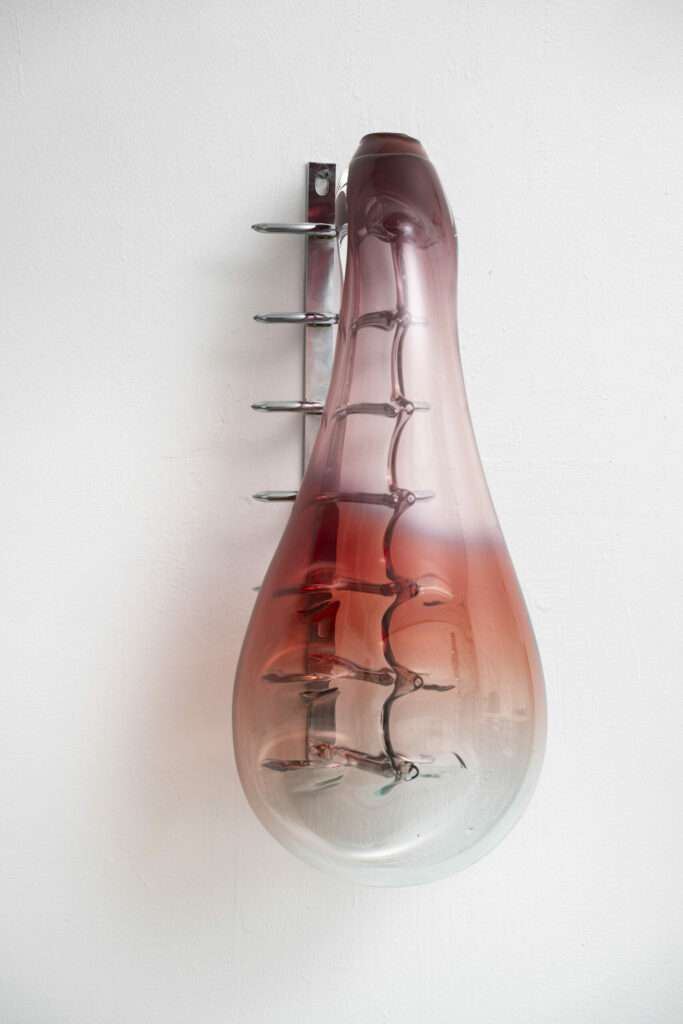
Gabriele Beveridge, Scaffold, 2026 courtesy the artist, Seventeen Gallery
Seventeen Gallery (London)
I am drawn to Gabriele Beveridge’s blown-glass sculptures, shaped in anthropomorphic forms. Glass is one of her preferred materials, valued for its fluidity; among the others she favours are photograms, appreciated for similar chemical properties.
The American artist Erin O’Keefe also commands attention with her trompe-l’œil works. Originally trained as a photographer and architect, she plays deliberately with ambiguity. Her work is also featured on the MAMCO acquisitions wall, « In course of Acquisition » program.
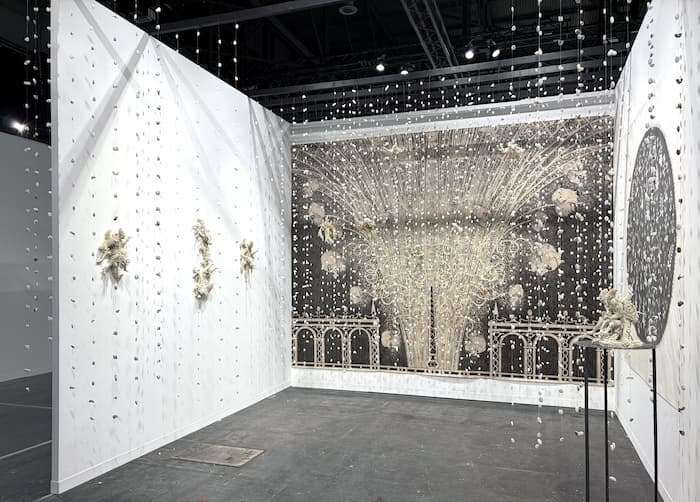
Mezzanin, Art Geneva 2026 solo show Diego Cibelli
Mezzanin galerie (Geneva)
Diego Cibelli’s highly noted solo show unfolds like a porcelain fantasia, restaging a suspended operatic scene. The biscuit porcelain technique, particularly delicate, is central to the work’s refinement. Also worth noting are the hybrid compositions by Lou Masduraud, whom I interviewed following her solo exhibition at Le Grand Café in Saint-Nazaire.
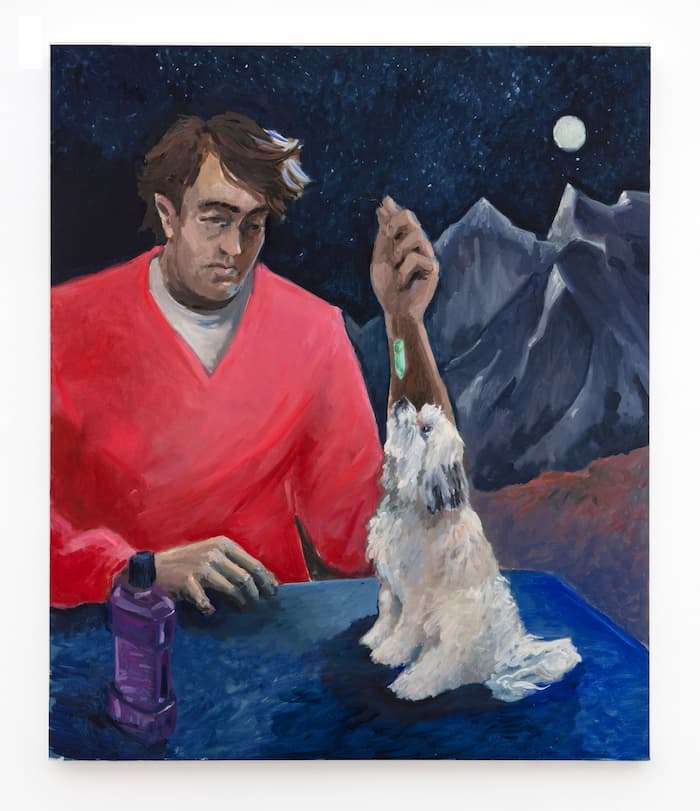
Charles Hascoët, Cottage Core, 2024 courtesy the artist, Danysz
DANYSZ (Paris)
The gallery presents new paintings by the self-taught artist and boxer Rakajoo, whom I previously interviewed. Recently exhibited at the Palais de Tokyo, he captures the everyday life of his neighbourhood, La Goutte d’Or, in works that unfold like storyboards. Alongside him, the stand brings together the romanticism of Charles Hascoët—also previously encountered—and Cécile Cornet’s compositions, which explore stereotypes of femininity.
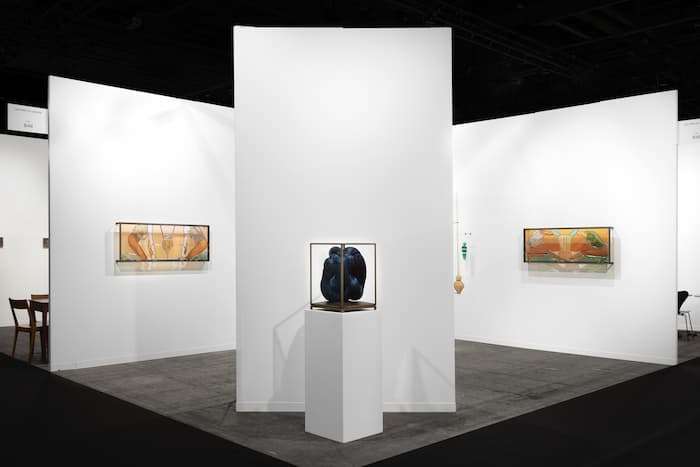
Les Filles du Calvaire, Art Geneva 2025 pic. Simon Rao
Les Filles du Calvaire (Paris) : female duo show
The artist Clara Rivault, who made a strong impression with her first exhibition at the gallery through a body of work focused on collaborative and know how practices engaging weaving (see my interview), is now exploring stained glass. She is shown alongside British artist Kate McGwire, whose feather-based sculptures are at once unsettling and imbued with a sense of magic.
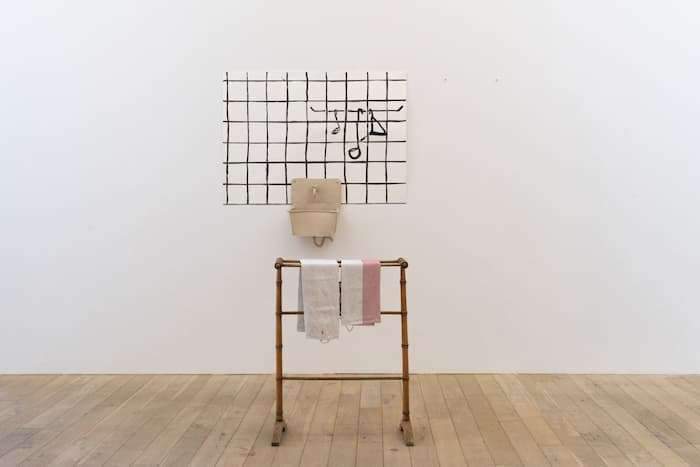
Zilla Leutenegger, Lavabobo, 2025
Installation, single channel video projection, acrylic on paper, ceramic, towel rack. Galerie Peter Kilchmann
Galerie Peter Kilchmann (Paris, Zurich) :
Among other artists, Zilla Leutenegger stands out.
In the video installation Lavabobo (2025), the video appears only fleetingly, the work’s focus lies in its sculptural presence. On the wall, a grid of black lines on white paper evokes tiles, suggesting simple kitchen utensils in the spaces between. Below, a small ceramic sink hangs, from whose hose projected droplets of water repeatedly fall.
From fragments of everyday life, Zilla creates memories as spaces and spaces that themselves become memories. Lines, light, and materiality intersect: the drawing extends into the surrounding space, the video becomes physically tangible. A dense experience emerges in which time and perception converge, a quiet, playful shift in reality.
On the Prize Front:
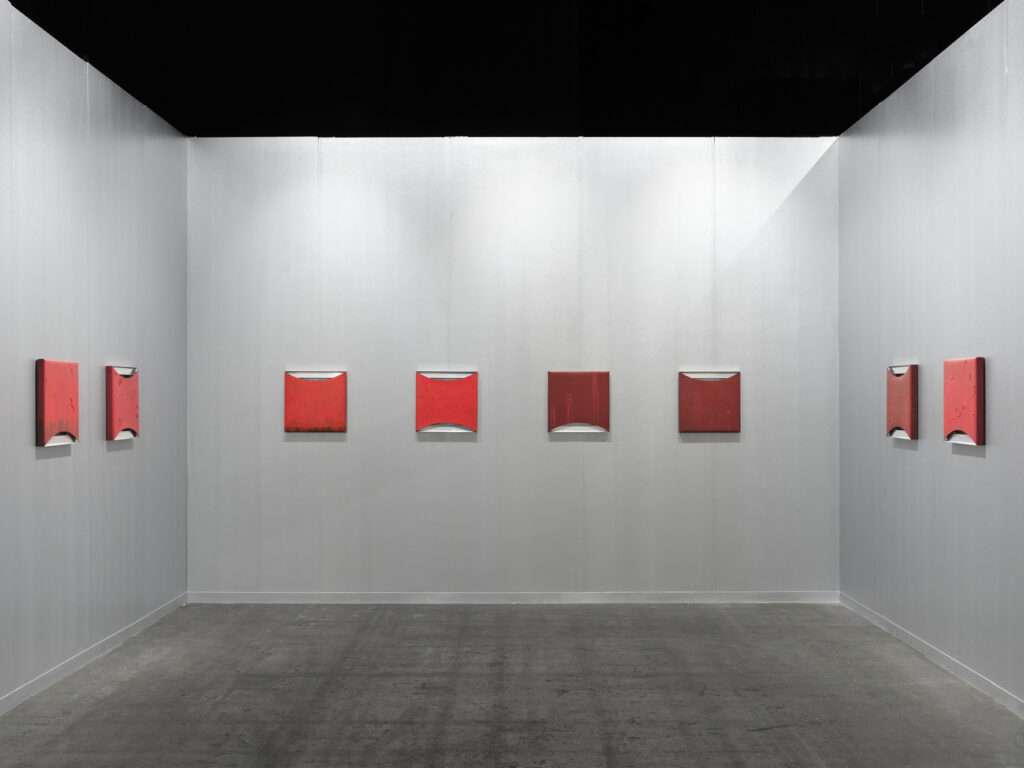
Reginald Sylvester II, courtesy of the artist, Maximilian William, Solo Art Genève 2026 Thomas Annaheim Lambert photography
Solo Art Genève–Piaget Prize
It is awarded to American artist Reginald Sylvester II, represented by Maximilian William gallery (London). His reuse of materials in paintings that verge on the tactile—particularly in the Offering series—won over a jury composed of Kathrin Bentele, Director of Fri-Art (Fribourg); Céline Poulin, Director of FRAC Île-de-France; and Nicolas Trembley, curator and collection manager of the Syz Collection. On this occasion, two works from the winning stand have entered the collections of MAMCO.
The award also provided an opportunity to highlight the return of British galleries in a post-Brexit context, as previously underlined by Charlotte Diwan. The Solo section was significantly expanded for this year’s edition.
The Molière Prize: 30 Years !
Founded in 1996 under the name Young Art and now known as the Molière Prize, the award supports the emerging Swiss and international art scene with a grant of CHF 30,000. The seven artists shortlisted for the 2026 prize—presented on a large dedicated stand—were Anita Muçolli, Ilaria Vinci, Monika Emmanuelle Kazi, Lorenza Longhi, Yoan Mudry, Cassidy Toner, and Gaia Vincensini.
The prize was awarded to American artist Cassidy Toner for her witty and mischievous approach to the mechanisms of the art world. Her ceramic series Besides the Point was recently shown at the Kunstmuseum Basel as part of another distinction, the Manor Art Prize—placing her firmly on the Swiss radar. My personal preference, however, went to Monika Emmanuelle Kazi, French artist based in Geneva, whose work weaves intimate deviations into diasporic memory.
Swiss cultural institutions :
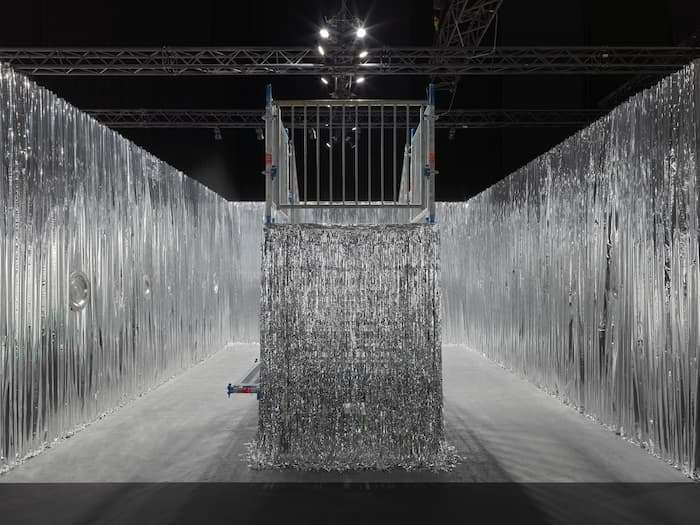
MAH Genève at Art Genève 2026 pic. Annik Wetter
MAH Genève : Installation by John M. Armleder
In response to his carte blanche at MAH Geneva, invited by Marc-Olivier Wahler, (read my interview) the celebrated Genevan artist presents one of his most striking interventions in the museum’s room dedicated to weapons and armor. As a conscientious objector, Armleder covers all the display cases with mylar, a reflective silver film, disrupting our perception and transforming the space. His sigh-specific installation for all the museum is undoubtedly one of the highlights of Geneva Art Week. For the fair, he invites the public to gain perspective from this new viewpoint.
Next: an interview with Danaé Panchaud, Director of the Centre de la Photographie, Genève featuring a duo show of Swiss artists : Yvan Alvarez and Bernard Tullen.
Practical Infos :
Art Geneva, 14th edition
Until Feb. 1st
Tickets
Opening hours:
Thursday: 12pm – 7pm
Friday: 12pm – 8pm
Saturday: 12pm – 7pm
Sunday: 12pm – 6pm
Geneva Art Week : general program in the city