
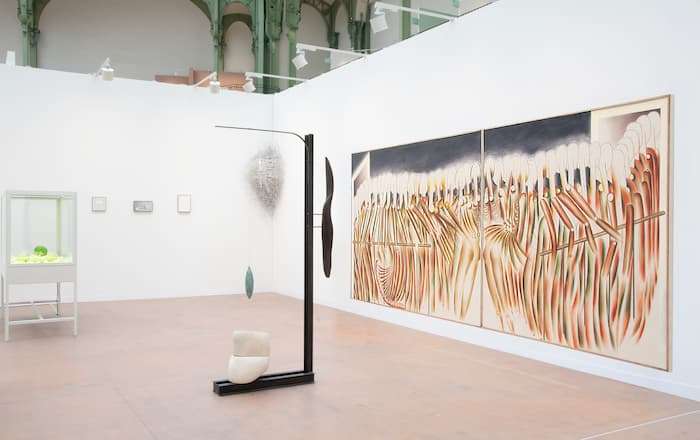
Booth View, Galerie Jocelyn Wolff, Art Basel Paris 2026 Pic. Chloé Philipp
We met Jocelyn Wolff during Art Basel Paris 2025, on the occasion of the gallery’s expansion into Seoul. A year later, he reflects on the mixed outcome of that edition of the fair, which took place against a backdrop of riots and violence. Following a strongly worded appeal from French galleries, represented by the CGPA, over the fair’s early closure, the Art Basel organising team agreed to provide compensation.
As both an Art Basel expert and Deputy President of the CGPA, Wolff considers the fair’s response commensurate with the damage suffered. His own gallery was directly affected by the decision, as it is located in a high-risk area where security measures had a considerable impact on its activities. The Abraham & Wolff space was similarly affected.
Beyond the financial losses, Jocelyn Wolff is concerned about the proliferation of fake news surrounding the gallery profession and the art world, which is all too often portrayed as disconnected from contemporary issues.
He offers a broad analysis of the market’s evolution, with particular attention to Asia. Having just returned from Tokyo, he observes how the globalisation we once knew is giving way to new patterns of circulation and a redistribution of power, with American dominance gradually receding.
In terms of the gallery’s programme, the carte blanche given to Katinka Bock by the Fondation Le Corbusier at Maison La Roche was an extraordinary experience. So, too, was the decision to collaborate with British artist Cathy De Monchaux, whose work is currently enjoying a genuine rediscovery.
Although he is not taking part in Paris Photo, Jocelyn Wolff is exhibiting and championing the work of Franco-Bolivian artist Mélissa Boucher Morales, whose practice explores the outer reaches of image-making and experimentation.
It is the new fair Signatures, however, that has particularly caught his attention. Wolff is himself a collector of multiples, and his gallery space on Rue des Saints-Pères is dedicated to promoting and disseminating this very type of work. Jocelyn Wolff answered my questions.
MdF. What is your assessment of Art Basel Paris, and in particular, how do you view the form of compensation offered by the organisers following the CGPA’s claims?
JW : I did indeed find myself in a somewhat paradoxical position. On the one hand, as Deputy President of the CGPA, I was sympathetic to the galleries’ reaction to the decision to close the fair early. On the other, I am a member of the fair’s Selection Committee, which also implies a certain degree of loyalty.
I feel deeply committed to both, so I found myself at the heart of the discussions, with perspectives that were not necessarily aligned. That said, I think the solution that was ultimately reached was truly generous. That is the word that comes to mind, and I can’t think of a better one.

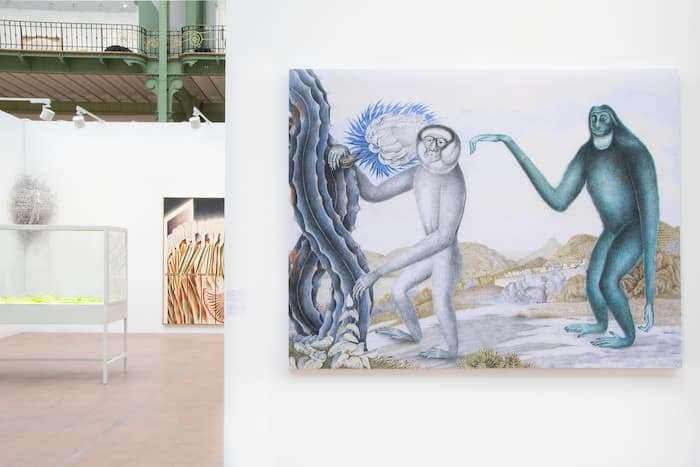
Booth View, Galerie Jocelyn Wolff, Art Basel Paris 2026 Pic. Chloé Philipp
MdF. Does this represent a significant effort on the organisers’ part?
JW. For Art Basel, the impact was considerable, given that the fair lost two days of public opening. On the days when it was able to welcome visitors, attendance was slightly higher than last year, so we could potentially have expected a record-breaking edition.
Of course, many collectors also cancelled their visits at the last minute, and this inevitably had consequences for the galleries.
In this context, I consider the 20% discount to be a significant gesture. It reflects a genuine commitment to establishing the fair in Paris for the long term. Above all, it shows that Art Basel truly regards galleries as essential partners, rather than interchangeable players.
MdF. French galleries nevertheless feel that they were not sufficiently involved in the decision-making process. What is your view?
JW: In a way, whatever decision had been made, and however it had been reached, it would inevitably have drawn criticism. We also need to bear in mind that for Art Basel to forgo the revenue generated by an entire weekend is obviously not a decision taken lightly. Everyone was fully aware that it was a difficult call.
Ultimately, the criticism focused more on the way the decision was made, particularly the lack of consultation. Art Basel’s position was that there simply wasn’t enough time to consult everyone. The decision was therefore taken very quickly, in an exceptionally tense situation.
With a little hindsight, now that things have calmed down, we can of course revisit the whole process. But we also need to put ourselves back in the circumstances of the time. There were conflicting pressures, and genuine concerns about whether a level of security commensurate with an event of this scale could be guaranteed. There were also numerous messages and calls circulating on social media.
All of this created an extremely anxiety-inducing atmosphere, with a degree of panic and, above all, a significant loss of confidence in the French authorities’ ability to manage the situation. We hear much less about it today because things have since settled down, but at the time, this context inevitably weighed heavily on the decision.
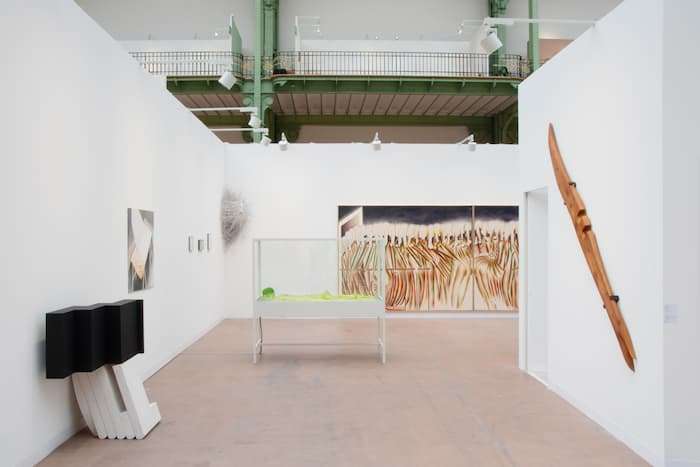
Booth View, Galerie Jocelyn Wolff, Art Basel Paris 2026 Pic. Chloé Philipp
MdF. Looking at your own experience, was the gallery adversely affected by the early closure?
JW: Yes and no. I think I had a very, very successful fair, but I am also convinced that it could have been even better, of course.
Above all, what I missed were the visits to the gallery over the weekend, particularly on Saturday. A large proportion of VIP clients, even when they have already made purchases at the fair, will often take the time to visit the gallery on Saturday as well.
I also had an opening scheduled for 17 October at the gallery on Rue des Saints-Pères. Several important clients were already in Paris, but none of them came. And I arrived at my own opening having to walk through clouds of tear gas! In 23 years of running a gallery, that had never happened to me before.
We really found ourselves in an entirely exceptional situation, with several different realities overlapping. On the one hand, there was a profoundly legitimate social movement, particularly from the perspective of young people, with which we felt a strong sense of solidarity. On the other, it was clear that the movement was also being hijacked by radical groups whose apparent aim was to bring everything crashing down. And then there was a third category: the looters, whose presence we were, in a sense, discovering on this occasion.
So we found ourselves confronted with these three dynamics unfolding simultaneously in the streets, each of them ultimately having the power to shape events in its own way!
MdF. Did the impressive large-scale skeleton by Francisco Tropa, which attracted considerable attention on your stand, find a buyer?
JW: Unfortunately, no.
In the case of this particular work, the clients I had been expecting ultimately didn’t make it, even though they were in Paris. They simply didn’t have time to come by. They had planned to visit on Saturday in particular. So, despite the success of the fair, there is inevitably a degree of frustration: we felt we were very close to closing certain deals, but in the end, they didn’t materialise. Other sales did take place, as is always the case at art fairs. And the work is still part of our inventory, so nothing is lost.
Beyond those two days of closure, however, I think Paris galleries were also greatly affected by the general atmosphere of panic, which inevitably had an impact on visitor numbers.
In our case, for example, we had to dismantle Santiago de Paoli’s exhibition at very short notice because some of the works were positioned too close to the windows. We had to find solutions in an emergency, which required a tremendous amount of our time and energy. Instead of being able to devote that time to our work and promoting our artists, we had to focus on logistical and security issues.
And then there is something else that I find particularly irritating: seeing all kinds of falsehoods about the art market circulating online, particularly from certain collectives. Take, for example, the claim that buying a work of art is nothing more than a way of obtaining tax benefits. This is obviously an extremely reductive view, and quite simply untrue.
We are faced with the extremely rapid spread of misinformation, whether it originates from the far right or the far left. And this ultimately undermines a profession that is, in fact, profoundly meaningful: enabling living artists to earn a living from their work and building a genuine economic ecosystem around their artistic practice. This is an issue of fundamental importance.
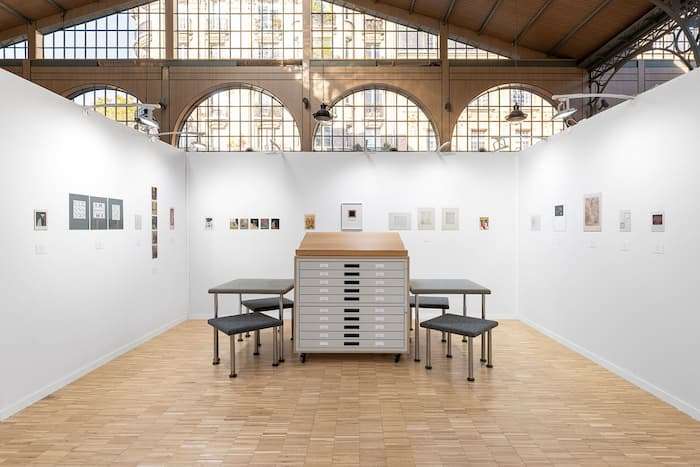
Booth View, Galerie Jocelyn Wolff, Signatures art fair
MdF. You take part in a considerable number of art fairs, and have stepped up your presence in Asia since establishing your gallery in Seoul. How would you assess the year as it draws to a close?
JW: It has been an particularly busy year. However, I would tend to distinguish between two types of art fairs: those that are genuine projects, involving a significant degree of risk-taking, and those I would describe more as “feel-good” fairs.
This year, we took part in a number of highly curated fairs, such as Paris Internationale in Milan. Then there is Kyoto, where I am participating for the first time, which falls more into the “feel-good” category. It is a very enjoyable experience: you are invited by another gallery, develop a project together, and work in a spirit of collaboration.
By contrast, some fairs require a much greater financial commitment from the gallery, which naturally generates higher expectations and, inevitably, a certain amount of stress.
Moreover, when taking part in a fair such as Art Basel Paris, we accompany it with an entire programme of events and projects across Paris, including the presentation at Le Corbusier’s Maison La Roche devoted to the artist Katinka Bock. As a Paris-based gallery playing on home turf, you feel that you have to go the extra mile. Art Basel Paris week therefore involves an enormous amount of work and comes with very high expectations.
It is much the same with Art Basel in June. We always develop a project there with Galerie Cahn, which specialises in archaeology. Here too, we try to go beyond simply taking part in the fair. We want to present prestigious works, or at least pieces that are entirely new to the market. This requires a considerable investment of time and energy.
Alongside these, there are more mid-range fairs, such as ARCO in Madrid, which offer greater opportunities to engage with museum audiences and curators. They allow us to develop an artistic programme somewhat independently of short-term market dynamics. Participation costs are also relatively reasonable compared with those of other international fairs.
Asia is a little different. Much of the work is handled by our local team, which means less day-to-day pressure for the Paris team. That does not mean, however, that there is any less work involved in the broader picture. We work on our inventory, projects and institutional relationships throughout the year. In reality, we are engaged with Asia on a permanent basis.
It is a part of the world I particularly enjoy working with, because we feel that we are achieving tangible results. A few days ago, for instance, I was in Nanjing, where we organised the first solo exhibition of Franz Erhard Walther in a private Chinese institution. His works from the 1960s are being activated there by young Chinese dance students.
There is something deeply rewarding about this work of promoting artists and reaching out to new audiences. We encounter people who are incredibly enthusiastic, who grasp the works very quickly and are genuinely eager to explore these cultural connections.
To sum up, despite the upheavals of this past year and an especially complex geopolitical climate, I remain fairly optimistic about the opportunities opening up before us. At the beginning of the year, I was in the Middle East, in particular, and was struck by an immense appetite for openness, by a desire to discover and forge new relationships.
We are, in fact, at a rather remarkable moment in the history of globalisation. The model we have known since the 1990s is coming apart and being reshaped. But that does not mean exchanges are coming to a halt. On the contrary, new routes, new networks and new ways of circulating artworks and artists are beginning to emerge.
Today, one can easily imagine a Brazilian artist holding their first international exhibition in Korea, without having to go through Europe or the United States. I find this an extremely interesting development, because it opens up far greater opportunities for artists from the Global South, who can now establish a presence and gain recognition through alternative international networks.
This is a very positive development, even though we ourselves are a European gallery.
We are also witnessing a certain decline in American hegemony. I think that, under Trump, the United States has lost much of its aura, and that it will find it quite difficult to regain it. In a sense, the country has turned inwards, becoming somewhat isolated, increasingly focused on its own situation rather than on the rest of the world. Perhaps this was also something it needed to do, given the significant domestic issues it had to address.
But this puts us at a rather interesting juncture, one in which we can champion a demanding, research-driven European artistic practice and find audiences for it all over the world.
That is very much our wager. This does not mean that we are seeking to represent every artistic scene on the planet through our programme. We neither have the means nor the pretension to do so, and in doing so we would risk losing the considerable expertise we have built up over the years around the artists we represent.
What we do know how to do, however, is build cultural bridges in many different directions.
MdF. Focusing on Asia in terms of turnover, what are the prospects?
JW: Although I don’t yet have a great deal of experience with Seoul specifically, I have been actively working in Asian markets for around ten years. I think it is important to distinguish clearly between the different countries, because the situations vary considerably.
China, for example, is no longer at all what it was ten years ago. It is now much less open. Korea, meanwhile, has seen the emergence of a particularly interesting art scene, with an exceptionally talented younger generation of artists. We are discovering remarkable individuals and artistic practices there. And, of course, there are also a great many exciting young artists in China.
Initially, you might enter these countries with the idea of developing a market, but ultimately you also discover artists. And as soon as you begin to invest more deeply in a local art scene, you meet curators, influential figures, partners and all kinds of potential allies, and above all, new audiences. That is how things take shape.
In terms of turnover, we already have some very important collectors in Asia who support us both in Paris and in Korea.
And that is precisely what makes it interesting: once we start circulating our programme, sales can happen anywhere. For example, when we organise an exhibition at Meyer Riegger Wolff in Seoul, certain works may already find buyers in Europe, even though our original intention was to sell them locally in Korea. Conversely, we might present an exhibition by a Chinese artist here and sell some of the works in China.
Ultimately, the whole process is much more fluid than one might imagine. And I believe that this is precisely the role of a gallery: to facilitate the circulation not only of artworks, but also of ideas.
MdF. Your participation in Frieze London with a solo presentation by Miriam Cahn: how would you assess the experience?
JW. This was my first time taking part in Frieze London, and we presented a major installation by Miriam Cahn, which was ultimately sold. It was a particularly ambitious work, subject to a very specific protocol: it could only be acquired as a whole.
This was therefore our first participation in this section. Previously, we had taken part in Frieze Masters several times, as part of curated sections.
The audience is also quite different from the one we encounter in Paris, with relatively little overlap between the two. It is therefore an interesting opportunity for us to reach new collectors and art enthusiasts.
And London remains a fantastic city. We took the opportunity to spend some time there and explore the full range of its cultural and artistic offerings.
MdF. And what about Frieze Abu Dhabi?
JW. It is not part of my plans at all for the time being.
The Middle East is a region where we would certainly like to establish a presence one day. But we cannot be everywhere, and we have to be selective about the opportunities we pursue.
For now, we prefer to develop our relationships with Middle Eastern collectors who come to Paris or London, rather than establishing a presence in the region ourselves. We also have to take into account the geopolitical situation and the region’s instability. For security reasons, people with a certain level of wealth often maintain a base elsewhere, in another city.
MdF. Returning to Katinka Bock’s project at Maison La Roche: what makes this off-site exhibition such an exceptional undertaking?
JW. It really is an extraordinary project. First of all, we were absolutely thrilled at the prospect of having access to such a remarkable venue.
There had been other projects there before, notably with Peter Doig, but I feel that this particular interplay between the venue and the artist’s response to it had never been explored in quite this way. Katinka Bock has created an absolutely remarkable sculptural work, drawing in particular on the colours and architectural features of the house. The result is a kind of organic, almost living presence. A truly exceptional artistic alchemy took place.
We also worked under excellent conditions with the Fondation Le Corbusier. It is an institution that pays very close attention to conservation issues. The house is, of course, a place that deserves to be opened up to the public, but it is also extremely fragile and sensitive to visitor numbers.
Paradoxically, we may even have benefited from the fact that the gallery was closed on 24 October: it meant I could be there in person to welcome visitors who were in Paris.
But beyond these practical considerations, the experience was absolutely extraordinary. We genuinely felt that we had achieved something almost magical. It was also an opportunity to appreciate how Katinka Bock’s practice has evolved, gaining ever greater scope and strength.
This is exactly the kind of project I believe is important for a Parisian gallery. When galleries manage to present exceptional works on their fair stands, put on ambitious exhibitions in their own spaces, or develop off-site projects, whether as part of an art fair or in heritage settings such as this one, they help raise the profile of the entire art scene.
Paris has an absolutely extraordinary potential. We have barely scratched the surface.
And I believe that if, collectively, we can build a society with greater social equality, give young people a stronger voice, and enable the state to place greater trust in intermediary organisations, then we could go even further. Because art is by no means disconnected from society.
Currently at the gallery :
Mélissa Boucher Morales
LOOKING FORWARD, BACKWARD
Until December 23, 2026
Galerie Jocelyn Wolff
Paris – Matignon
https://www.galeriewolff.com/exhibitions
Abraham & Wolff
Ao Jing
HERE AND NOW
Until : December 24, 2026