
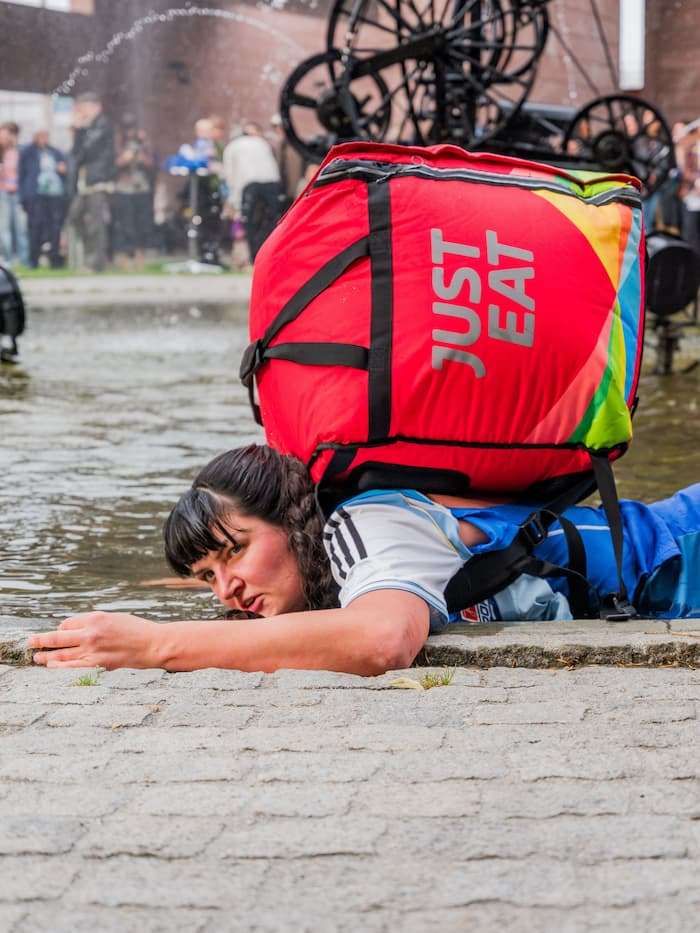
Exhibition Labouring Bodies, vernissage, Ernestyna Orlowska, Make Your Body Your Machine, 2021, Museum Tinguely, Basel, 2026 Photo credit Pati Grabowicz
Opening of Art Week in Basel ! The exhibition Labouring Bodies, A History of the Mechanization of the Feminized Body explores at Museum Tinguely the historical and ongoing exploitation of women within capitalist and patriarchal systems, where labour has long been distributed along gendered lines. From unpaid care work to clerical and administrative tasks assigned to women through technologies such as typewriters, photocopiers, and computers, the exhibition examines how mechanization has shaped both work and the body itself.
Particular attention is given to the ways in which reproductive and affective labour : breastfeeding, pregnancy, caregiving, and emotional work have been framed as forms of productivity, transforming the female body into a site of continuous labour. The exhibition also addresses the political appropriation and regulation of women’s bodies within broader structures of power and control.
Drawing connections between the textile and computing industries, both historically dominated by male decision-makers despite relying heavily on female labour.
The parallel between these works highlights a continuity : across different historical moments, labour is often rendered invisible, fragmented, and detached from the bodies that perform it particularly when it is feminized or racialized. Nowadays, women and migrant workers continue to face low wages, precarious employment conditions, dependency, and inadequate workplace protections, while new forms of vulnerability have emerged especially in digital economy.
Although many of the featured artists identify with feminist perspectives, the curator Sandra Beate Reimann, emphasizes on their individual positions and artistic approaches rather than presenting a unified feminist narrative. She answered my questions.

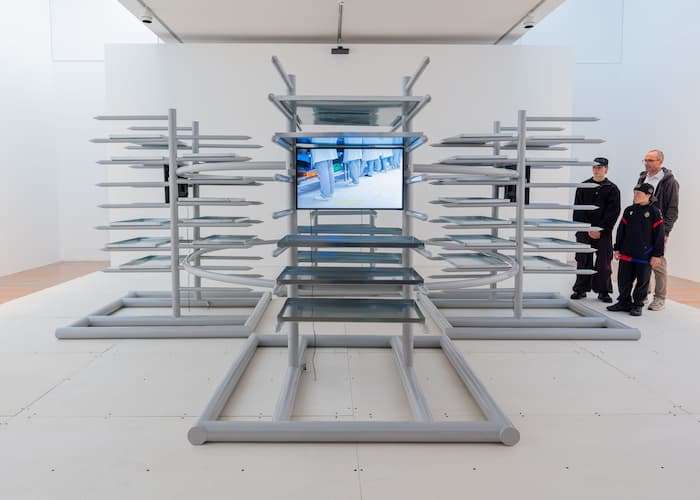
Exhibition Labouring Bodies, Museum Tinguely, Basel 2026 Doruntina Kastrati, A Horn That Swallows Songs, 2025 Photo credit Pati Grabowicz
Marie de la Fresnaye. What are the origins of this challenging project ?
Sandra Beate Reimann. A few years ago, I came across The Night Side, a film by Alexandra Navratil, which is now presented in the first room of the exhibition. The film follows a former worker from the East German film-manufacturing company Agcfa-ORWO, where more than eight thousand women were employed. It was even known as a Frauenbetrieb, a workplace largely staffed by women.
What struck me most was the way Navratil focused her camera on the woman’s hands as she recalled the work she had performed for many years. Navratil managed to reconnect with one of these former workers and returned to the factory site with her. Together, they revisited the spaces where raw film was produced under conditions of near-total darkness.
The worker described a routine that was both physically and psychologically demanding: she would leave for work before sunrise, spend the entire day in the dark, and return home after nightfall. The Night Side profoundly affected me and prompted a shift in my own perspective.
In the dominant narratives of modern art and industrial labour, it is usually the male worker, often white who is represented. If we think of Fernand Léger or even Charlie Chaplin’s Modern Times, the figure caught in the gears of industrial machinery is almost always male. I became interested in looking instead at women workers and at their relationship to machines, production, and industrial labour.
Once you begin to focus on women’s work, however, it becomes impossible to stop at wagged employment alone. Women have historically carried a “double shift”: alongside factory or office work, they were also responsible for unpaid domestic labour, caregiving, and reproductive work. Examining the female worker therefore means looking beyond the factory and considering the broader structures that organize labour and social reproduction.
This connection is particularly visible in the political imagery of the twentieth century. I included for example, one of the photomontages of John Heartfield from 1930s, which directly exposed how states sought to regulate women’s bodies in order to increase the labour force or, in times of war, to produce future soldiers. These works reveal how closely the politics of reproduction and the politics of labour have always been intertwined.

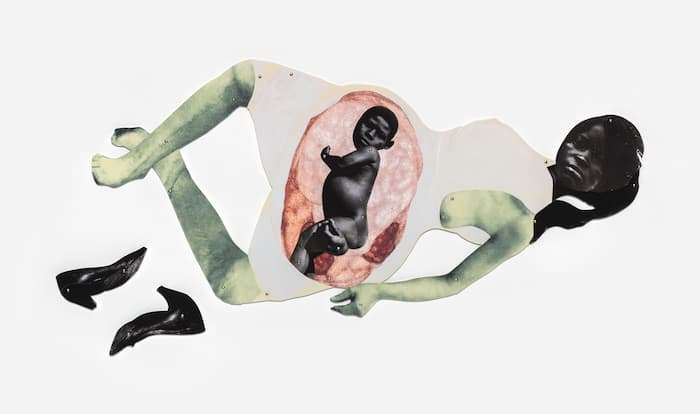
Frida Orupabo, Baby in belly, 2020 Collezione Sandra e Giancarlo Bonollo
Photo Credit: Courtesy of the artist and Stevenson Cape Town | Amsterdam, Mario Todeschini
How did you select the artists ?
From the outset, it was important for me to address both production and reproduction, and to bring these two spheres into direct conversation. Too often, they are treated separately, even though they are deeply interconnected. One of the key works in the exhibition is a piece by Mary Kelly from 1974, which we were able to reconstruct for the first time since its original presentation. The work juxtaposes images of the artist’s pregnant belly with footage of a woman working in a metal-box factory, creating a powerful visual link between industrial labour and reproductive labour.
Throughout the exhibition, I wanted to weave these dimensions together rather than present them as distinct categories. The exhibition therefore moves across several interconnected themes. One of them focuses on specific technologies associated with women’s work, such as the typewriter, which eventually gives way to the computer, as well as photocopying machines and other tools linked to stereotypically feminized office jobs.
Another thread explores the historical relationship between weaving and computing. This connection reveals how textile production and digital technologies share common histories and structures. The development of computing owes much to techniques and concepts that emerged from weaving, an industry in which women’s labour played a central role.
A third area of interest concerns the ways in which care work, domestic labour, and reproductive work have themselves become increasingly technologized. From the 1970s onward, household appliances such as refrigerators, washing machines, and dishwashers were marketed as tools of liberation that would free women from domestic burdens. Yet these technologies often reinforced existing expectations around gender and household responsibilities rather than fundamentally transforming them.
One particularly telling example is the breast pump. Patented as early as 1854 and later made widely available, it illustrates how technologies designed to support care work can simultaneously increase the efficiency, regulation, and management of the body. Such devices reveal the complex relationship between technology, labour, and the ongoing mechanization of everyday life.
As exemplified in Ani Liu’s work ?
Yes. What interests me is that technology makes these dynamics visible as part of a larger system. It reveals the structural dimension of labour and care, while also exposing the limits of technological solutions. These mechanisms are often not immediately apparent ; they operate as invisible, underlying structures that shape everyday life.
Take the breast pump, for example. It creates a connection between feeding a child and remaining available for paid work. In one sense, it offers greater flexibility and autonomy. It allows women to reconcile different aspects of their lives in ways that were previously more difficult.
At the same time, however, it generates new expectations. Rather than reducing demands, technology can expand them. The possibility of combining childcare and professional work often becomes an obligation to do both simultaneously: to maintain a full-time career while also caring for a very young and highly dependent child.
This is a recurring theme throughout the exhibition. Technologies that are presented as tools of liberation can also reinforce existing social expectations. They offer new forms of freedom, but they may also intensify the pressure to be constantly productive, both as a worker and as a caregiver.
Alexandra Bircken « Build Your Dreams » is facing the first ready-made in art « Roue de Bicyclette » through gender lens
Alexandra Bircken’s work has long explored the relationship between machinery, technology, and forms of masculinity traditionally associated with them. At the same time, she comes from a background in fashion design, which gives her a particularly strong connection to textiles and textile production. This dual perspective made her work especially relevant to the exhibition.
We are showing three of her works, and, as with several artists in the exhibition, her practice appears in more than one context. I chose to place two of the pieces in a room dedicated to textiles and the history of the textile industry because they resonate strongly with the themes explored there.
One of the works, Parenthesis, immediately caught my attention. It references Marcel Duchamp’s famous ready-made, Roue de bicyclette. At the same time, the piece evokes a spinning wheel, a tool historically associated with textile production. In Bircken’s interpretation, however, the wheel is a motorcycle wheel. I found this juxtaposition particularly compelling: the motorcycle, often coded as masculine, intersects with the spinning wheel, a symbol of feminized labour.
The second work Build Your Dreams is installed nearby. Bircken constructed it from automobile cables, transforming industrial materials into a sculptural form. What I find fascinating about this piece is the way it brings together different technological histories. The woven structure of the cables recalls textile techniques, while their function as conduits for information and energy points toward the history of computing and communication technologies.
Together, these works embody one of the exhibition’s central concerns: the often-overlooked connections between textiles, technology, industry, and gendered forms of labour. They reveal how these histories are deeply intertwined, even when they are usually presented as separate narratives.

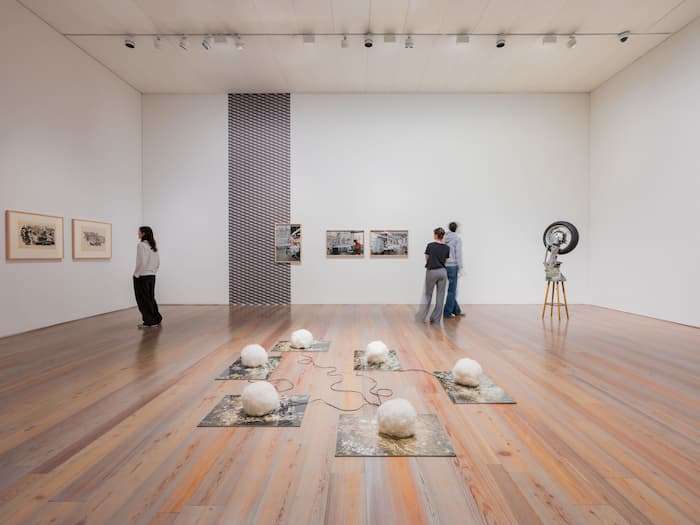
Exhibition Labouring Bodies, Museum Tinguely, Basel 2026 Photo credit Pati Grabowicz
Is Jean Tinguely the only male artist in the exhibition? There is an interesting link between his work and Rebecca Horn’s
The exhibition includes only two male artists, and both are present for very specific reasons. One is John Heartfield, represented by his photomontage Zwangslieferantin von Menschenmaterial (“Forced Supplier of Human Material”), and the other is Jean Tinguely, whose work offers a particularly interesting perspective on the relationship between machines, gender, and labour.
Tinguely’s sculpture Olympia consists of a female torso assembled from two old, rusted Olympia typewriters. The work transforms office machinery into a torso making visible the historical association between women and clerical technologies. Installed across from it is a work by Rebecca Hornentitled Erika, creating a dialogue between the two pieces.
What interested me in bringing these works together is the history embedded in their titles. Olympia was not only a typewriter brand ; it belongs to a wider tradition of assigning female names to technologies. Throughout the twentieth century, typewriters were marketed under names such as Olympia, Erika, Regina, Mercedes, or Elektra. This phenomenon has by no means disappeared. We can still see it today in voice-controlled technologies such as Siri or Alexa, which continue to personify machines through female identities.
These works point to a broader historical moment : when writing shifted from an intellectual or creative activity to a repetitive, mechanized task, women increasingly entered the profession. Typing, filing, and administrative work became feminized forms of labour. The exhibition includes historical photographs showing rows of women seated at typewriters and adding machines, often under the supervision of male managers. These images reveal how office work was organized according to strict gender hierarchies and how certain activities came to be defined as “women’s work.”
By juxtaposing these artworks with archival material, I wanted to highlight the ways in which technology, language, and representation have contributed to the construction of gendered labour roles. The machine is not simply a tool; it also becomes a site onto which social expectations, power relations, and ideas about femininity are projected.

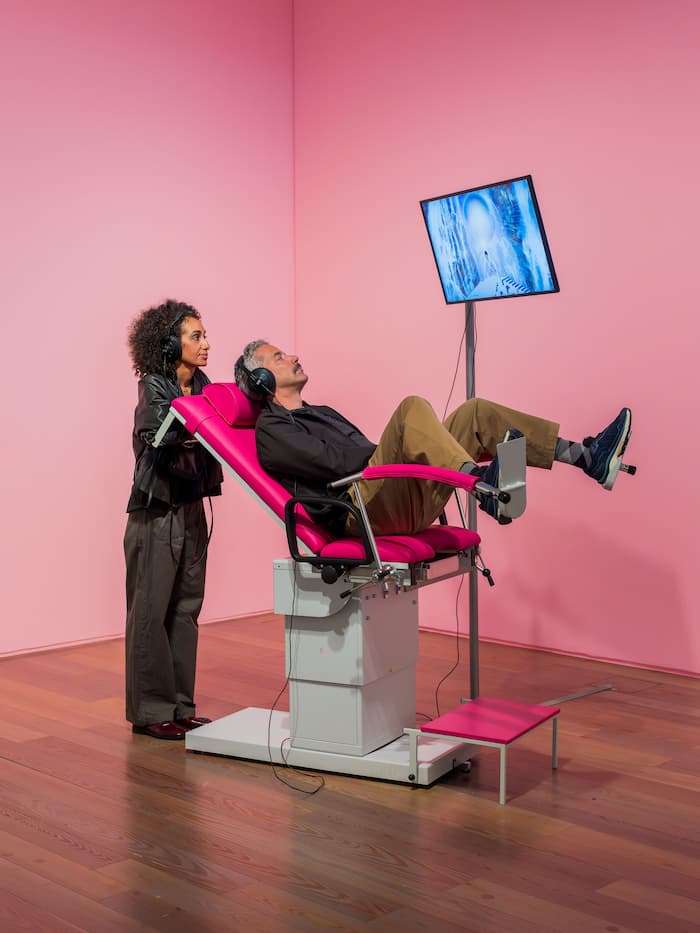
Tabita Rezaire, Sugar Walls Teardom, Tabita Rezaire and Goodman Gallery
© 2026 ProLitteris, Zürich
Photo Credit: 2026 Museum Tinguely, Basel; Pati Grabowicz
To what extent is feminized labour in computing and technological progress, another key topic ?
Another important reference in the exhibition is Berenice Abbott’s photograph IBM Factory, 1958. The image captures a moment in the history of computing that is often associated with technological progress, yet it also invites us to consider the forms of labour that made such systems possible.
This perspective is echoed in the work of Patti Hill. Her photograph Electronic Plate (verso) emerged from an encounter with an IBM Copier II, a machine she used to produce her art. What interests me here is not only the technology itself but also the figure of the operator. Historically, the people who operated copying machines, typewriters, and early computer systems were very often women. These technologies relied on what I would call a serving body—a body positioned in support of the machine, performing repetitive and often invisible tasks essential to the circulation of information.
The exhibition seeks to uncover these largely hidden histories of women’s contributions to computing and technological development. One particularly moving example is the work of Rosa Barba, Send Me Sky, Henrietta. The piece pays tribute to Henrietta Swan Leavitt, whose painstaking calculations led to a breakthrough method for measuring distances in the universe. Although her work was fundamental to modern astronomy, her contribution remained overshadowed for many years, reflecting a broader pattern in the history of science and technology.
More broadly, the exhibition examines how technological innovation has often depended on forms of labour that were feminized, marginalized, or rendered invisible. This interwoven history of gendered and racialized labour is also present in the work of Marilou Schultz. Drawing on Navajo weaving traditions, her practice highlights the deep connections between textile production, mathematical systems, coding, and communication technologies. Through her work, weaving emerges not as a pre-industrial craft opposed to technology, but as a sophisticated knowledge system that has much to tell us about the histories of computation and information processing.
Why did you choose the artists’ collective Mbuku Kimpala Cercle d’Art des Travailleurs de Plantation Congolaise (CATPC), which was presented at the Venice Biennale?
The work of the collective CATPC addresses a wide range of issues, but one of its central concerns is the extraction of resources, knowledge, and symbolic capital from the Democratic Republic of the Congo and their transfer to Europe. Their practice examines the enduring legacies of colonialism and the ways in which systems of exploitation continue to operate in the present.
I chose to include their sculpture Lady of Museums because it resonates strongly with the exhibition’s broader reflections on labour, reproduction, and the body as a site of extraction. The sculpture depicts a mother and child, but the relationship between them is deeply unsettling. Rather than appearing vulnerable or dependent, the child becomes an aggressor, seemingly drawing sustenance directly from the mother’s brain.
For me, the figure of the mother functions here as a powerful metaphor. She embodies a territory whose resources have been continuously appropriated by others.
What interests me is the way the sculpture presents the maternal body as a resource in itself—a source of material, intellectual, and symbolic wealth that is constantly being consumed. In that sense, the work extends one of the exhibition’s key themes: the relationship between care, reproduction, and extraction. The mother is not only a caregiver; she is also positioned as a provider of value for economic systems that depend on her labour while simultaneously depleting her resources.

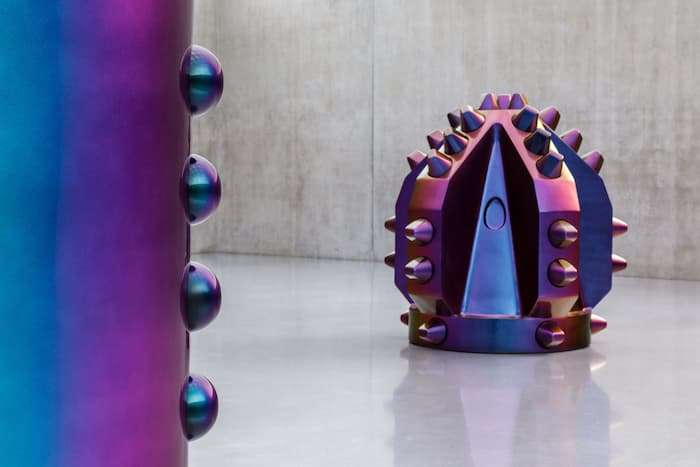
Monira Al Qadiri, Alien Technology (Diamond) 2023
Courtesy the artist, commissioned by Kunsthaus Bregenz
Photo Credit: Markus Tretter
How does Monira Al Qadiri challenge traditional representations of oil extraction ?
Not all of the works in the exhibition are connected through a single narrative. I also allowed myself the freedom to create unexpected associations and dialogues between works that approach similar questions from very different perspectives.
The work of Monira Al Qadiri is a good example of this approach. Much of her practice focuses on the history of oil extraction and its impact on the Gulf region, where she grew up. At the same time, she is deeply interested in the histories of labour that have been erased or displaced by the arrival of the oil industry.
Before oil became the dominant economic force in the Gulf, pearl diving was one of the region’s principal industries. It was a highly demanding profession carried out almost exclusively by men. In several works, Al Qadiri revisits this disappearing history and reimagines it through a speculative, future-oriented lens. One of her films features a group of synchronized female swimmers performing a choreography in the sea at night. The scene is both beautiful and uncanny: the dark water almost appears to be oil rather than seawater.
What fascinates me about this work is the way it creates an aesthetic and conceptual bridge between pearls and oil, past and present. At the same time, it introduces a gender reversa l: an activity historically associated with male labour is reinterpreted through the bodies of women. Through this shift, Al Qadiri questions how labour, value, and identity are constructed and transformed over time.
Her large rotating sculpture Diamond is also included in the exhibition. The work is based on the forms of industrial drill bits used in oil extraction. These are powerful tools that have traditionally been associated with masculine ideals of industry, conquest, and technological control. Their shape can even be read as overtly phallic.
Yet Al Qadiri complicates these associations. She transforms these heavy industrial objects into shimmering, jewel-like sculptures with iridescent surfaces. The result is a deliberate ambiguity: the works oscillate between attraction and violence, luxury and extraction, beauty and exploitation. It is precisely this tension that interests me.
For a long time, I had wanted to place Al Qadiri’s drill sculptures in dialogue with a painting by Lee Lozano. Both artists engage with forms that evoke power, desire, machinery, and gender, but in very different ways.
Data centers, invisible labor and hidden work in contemporary capitalism : what does Daniela Brugger argue?
What I found particularly striking is that, with the rise of data-driven labour, we are seeing the return of a form of work that already existed at the turn of the twentieth century: homework. In industries such as textiles in Switzerland, and also in the clock-making sector, many women worked from home in order to combine paid labour with childcare and domestic responsibilities. They would operate sewing machines or carry out repetitive tasks at home, often for extremely long hours and under conditions that were largely unregulated and beyond the reach of labour protections.
In many ways, this model of dispersed, invisible labour has re-emerged in today’s digital economy. What we tend to forget when we think about computing and artificial intelligence is that these systems are often imagined as clean, autonomous machines, supposedly intelligent systems that operate on their own. In reality, however, they rely on a vast global workforce.
According to estimates by the World Bank in 2023, there are approximately between 154 and 435 million people worldwide involved in data work e.g. labelling and image annotation to train AI systems. This work is frequently outsourced to precarious labour markets and is often carried out by refugees or workers in contexts with limited labour protections, although in reality it exists across many regions. It is also largelly performed by women.
In the exhibition, this hidden infrastructure of digital labour is addressed in a video and sculpture installation by Daniela Brugger, an artist based in Basel. She investigates the material conditions behind artificial intelligence by conducting interviews with workers developing what flash-fiction: short narrative fragments based on the experiences of a woman working as a content moderator and image sorter. Her task involves filtering between “clean” and “toxic” images—often highly disturbing visual material. The psychological impact of this work becomes central to the narrative, leading in the story to an internalisation of violence that spills over into her relationship with her own children.
I bring this contemporary perspective into dialogue with an historical photograph by Alice Lex-Nerlinger, which depicts homeworker in the textile industry superimposed by the portrait of a women. Therewith she questions the ideal of the new women in the German Weimar Republik with their working reality.
What are your curatorial approaches and main areas of research since your arrival at museum Tinguely ?
I have been working at the museum since 2014, and over the years I have explored different dimensions of time through materials and materialist perspectives. A few years ago, I curated a group exhibition entitled Territories of Waste, which examined another facet of contemporary material culture and its entanglement with present-day society.
Of course, the notion of the machine is deeply embedded in the DNA of the museum. However, one of the assumptions that this exhibition seeks to question is the idea that we have entered a “post-machine” or post-industrial era. The machine is often framed as belonging to a closed historical period, with exhibitions such as Pontus Hulten’s The Machine as Seen at the End of the Mechanical Age at MoMA reinforcing this narrative of an ending.
What I would like visitors to take away is the idea that mechanisation is not a finit historical period. It is an ongoing process that continues to shape our present. It affects people differently, distributes labour unequally, and produces new forms of hierarchy that persist to this day.
In my essay for the catalogue, I also draw on the work of Silvia Federici, who already in the 1970s described how capitalism subjected women to a specific and intensified form of mechanisation. Because of their socially assigned capacity for biological reproduction, women’s bodies have historically been treated as both labouring and reproductive machines, subjected to a double process of exploitation.
For Federici, there is no single, universal site of mechanisation of the body. Instead, there are multiple, historically situated processes that shape bodies differently depending on gender, race, and class. This multiplicity of histories is essential to understanding how mechanisation continues to operate today, beyond the boundaries of any single industrial era.
With : Berenice Abbott, Monira Al Qadiri, Rosa Barba, Clara Bausch, Alexandra Bircken, Thomas Brinkmann, Daniela Brugger, Ursula Burghardt, Feliza Bursztyn, CATPC, Mbuku Kimpala, Helen Chadwick, Sella Hasse, John Heartfield, Pati Hill, Rebecca Horn, Juliana Huxtable, Doruntina Kastrati, Mary Kelly, Aurora Király, Kiki Kogelnik, Azade Köker, Suzanne Lacy, Magda Langenstraß-Uhlig, Alice Lex-Nerlinger, Elisabeth Niggemeyer, Ani Liu, Lee Lozano, Alexandra Navratil, Katja Novitskova, Ernestyna Orlowska, Frida Orupabo, Heiner Ranke, Margaret Raspé, Tabita Rezaire, Evelyn Richter, Niki de Saint Phalle, Marilou Schultz, Jean Tinguely, Ruth Wolf-Rehfeldt, Doris Ziegler.
Practical Info :
Labouring Bodies
Until November 8
Museum Tinguely
https://www.tinguely.ch/en/exhibitions/exhibitions/2026/labouring-bodies.html
Arty summer around Art Basel :
Enjoy one of the Rhine riverside refreshment stands for an evening and take some time to stroll after the art marathon.
City-Guide :