
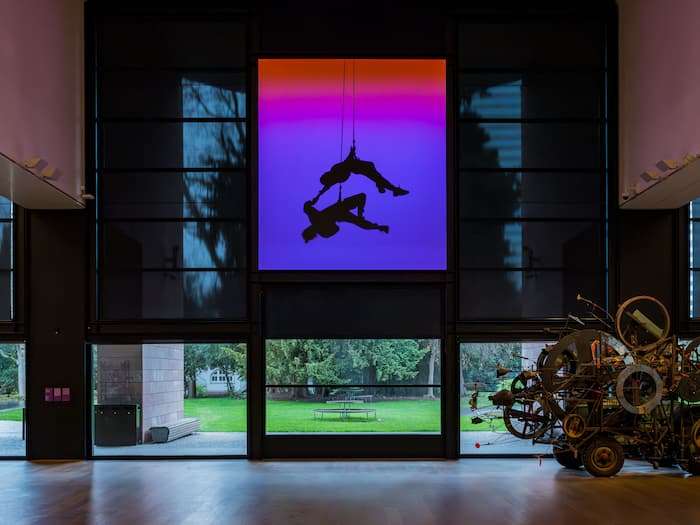
Angelica Mesiti. Exhibition view Reverb, Museum Tinguely, Basel, 2026. Angelica Mesiti, Sidereal (video still), 2024. © 2026 ProLitteris, Zurich; Copyright the artist. Courtesy the artist, Galerie Allen, Paris, and Anna Schwartz Projects, Melbourne
On the occasion of the first exhibition dedicated to the Australian artist Angelica Mesiti in Switzerland at the Museum Tinguely, meeting with Tabea Panizzi, curator.
Reverb presents five video installations within the permanent exhibition and the collections, in dialogue with the dynamic thinking of Jean Tinguely. Formal and conceptual echoes emerge around acoustic phenomena and the viewer’s role within the very apparatus of the artwork. A poetic approach to everyday enchantment and its reverberations in space and time.
The most recent video installation, The Rites of When, centered on the cycle of the seasons and customs linked to harvest celebrations, placed close to Tinguely’s Mengele Dance of Death , proves to be particularly significant and served as the starting point for the entire project, as she emphasizes. Angelica Mesiti’s exploration of performative, and non-verbal modes of communication are closely aligned with the sensory approaches we promote here at the museum, Tabea adds.
Tabea reflects on her beginnings and early experiences at the museum, the landmark exhibitions she organized with the director Roland Wetzel, and what fascinates her about Tinguely’s universe and the possible connections with many other artists. Among the themes close to her heart is the place of women artists—a focus she shares with her colleague’s upcoming museum exhibition Labouring Bodies, curated from a feminist perspective. She answered my questions.

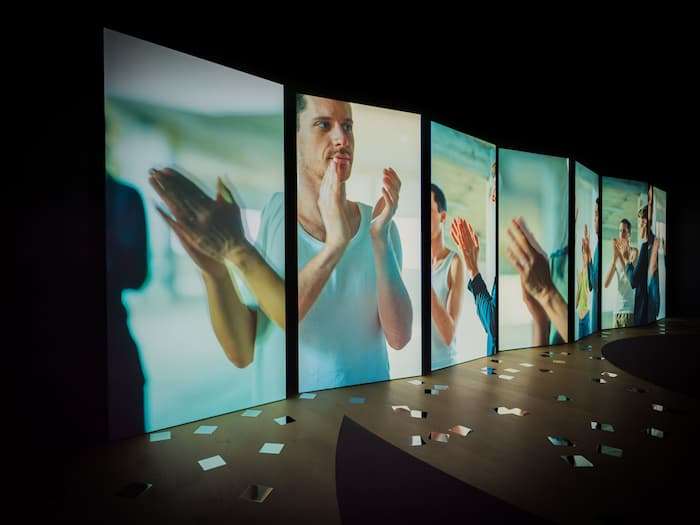
Angelica Mesiti. Exhibition view Reverb, Museum Tinguely, Basel, 2026. The Rites of When. © 2026 ProLitteris, Zürich; Copyright the artist. Courtesy the artist, Galerie Allen, Paris, and Anna Schwartz Projects, Melbourne
When did you start at Museum Tinguely ? Were you familiar with his work ?
I joined the museum in 2021, with only a limited familiarity with Jean Tinguely’s work. While I was aware of a few iconic pieces, such as the Fontaine Igor Stravinsky near the Centre Pompidou, my deeper engagement with his practice truly began once I took up my position.
My initial role focused on temporary exhibitions rather than directly on Tinguely’s works and its presentation at Museum Tinguely. One of my first projects was Party for Öyvind, an exhibition dedicated to Öyvind Fahlström and his artistic networks in Sweden and New York. I worked as an assistant to Roland Wetzel, which provided an invaluable introduction to curatorial practice. In addition, I contributed to presentations of the museum’s collection, offering me the opportunity to explore Tinguely’s oeuvre in greater depth, as well as the institution’s extensive archival holdings.
Since then, I have been involved in around ten temporary exhibitions. What stands out in the museum’s programme is its accessibility: the exhibitions are designed to engage the senses and invite audiences in, regardless of their prior knowledge of art.
Among the projects that left a strong impression on me was the exhibition by Janet Cardiff and George Bures Miller. Spanning three floors, it featured immersive installations that drew visitors into layered, narrative environments, at once interactive, atmospheric, and at times almost magical.
Another significant project was Fresh Window, a group exhibition I co-curated with Andres Pardey and Adrian Dannatt. The exhibition explored the relationship between shop windows and the art world, taking as its starting point Tinguely’s early career as a window dresser. This research led us to a wide range of artists who either began their careers in window display or incorporated it into their artistic practice, including Christo, Andy Warhol, Robert Rauschenberg, and Jasper Johns.
The project highlighted how the shop window operates as a multifaceted cultural space—one that reflects broader social dynamics and everyday concerns. As a ubiquitous element of urban life, it offers a compelling lens through which to examine the intersection of art, commerce, and society. In particular, female artists like Marina Abramović or Maria Teresa Hincapié, have also used the shop window for performances in which they critically questioned gender roles or the power of the male gaze.
Regarding Angelica Mesiti. What was the starting point of this challenging project ?
One of the project’s key starting points was her contribution to the 58th Venice Biennale in 2019, where she represented the Australian Pavilion with a large-scale installation titled Assembly. The work explored non-verbal forms of communication, as well as broader questions of plurality, society, and democracy.
Around the same time, the museum’s director and I visited her retrospective at the Palais de Tokyo, which offered a comprehensive overview of her practice up to 2018. He felt her work would resonate strongly with our programme, particularly our exhibition series dedicated to sensory approaches to art, an area that is central to the museum’s identity.
This focus on perception is also closely tied to Jean Tinguely’s work, where sound often plays a crucial role. It is equally significant in her practice, making the connection especially compelling. Following this, the director reached out to her, and I subsequently took over the project, working closely with the artist.
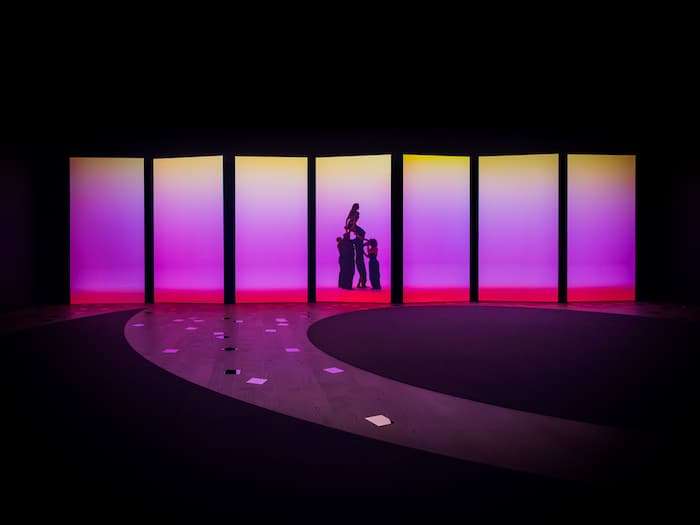
Angelica Mesiti. Exhibition view Reverb, Museum Tinguely, Basel, 2026. The Rites of When. © 2026 ProLitteris, Zürich; Copyright the artist. Courtesy the artist, Galerie Allen, Paris, and Anna Schwartz Projects, Melbourne.
What were the key curatorial considerations shaping her work with the collection ?
From the outset, it was clear that we wanted to present The Rites of When (2024) in Europe for the first time, here in Basel, marking the first major exhibition of Angelica Mesiti’s work in Switzerland. A key ambition was to include a large-scale installation that had not been shown in Paris, thereby giving the exhibition a distinct identity.
We felt the work would resonate particularly well in dialogue with Jean Tinguely’s Mengele–Dance of Death, located nearby. Tinguely incorporated elements from agricultural machinery and addresses cyclical themes of life and death. The notion of dance, as well as references to agricultural labour, are central concerns in The Rites of When, making this juxtaposition especially interesting.
This installation became the conceptual starting point, which we then sought to expand. Angelica Mesiti’s work frequently draws on everyday gestures and the poetry of daily life, an approach that naturally echoes Tinguely’s own use of ordinary objects. Establishing a dialogue between their practices felt both intuitive and productive.
From there, the process involved carefully selecting works in relation to the museum’s spaces. For instance, we decided to present Prepared Piano for Movers (Haussmann) in the museum staircase, while Sidereal was deliberately positioned at 5 m height; presenting it on a standard monitor at ground level would not have achieved the same impact. The aim throughout was to fully activate the architectural possibilities of the museum and to benefit from the monumental height of the exhibition hall
Finally, with Relay League, we were particularly interested in its connection to percussion and rhythm, which mirrors the mechanical, sound-producing sculptures in Tinguely’s work. This interplay between movement, sound, and machinery became a unifying thread across the exhibition.
Would you agree that colour in Sideral plays a key role in evoking the cycle of day and night ?
The use of colour has become particularly significant in her most recent works, Sidereal and The Rites of When. In a way, it introduces a painterly dimension, with colour taking on a central expressive role. The gradual shifts in tone also bring a temporal element into play, reflecting the changing light of a day, and in this way, embedding a sense of duration and transformation within the work.
As you suggested before, this opens up an interesting connection to Jean Tinguely’s early reliefs, which could be seen as a form of a “moving painting”. While this parallel had not initially been a conscious reference, it offers a compelling way of understanding the relationship between colour, movement, and time across both practices.

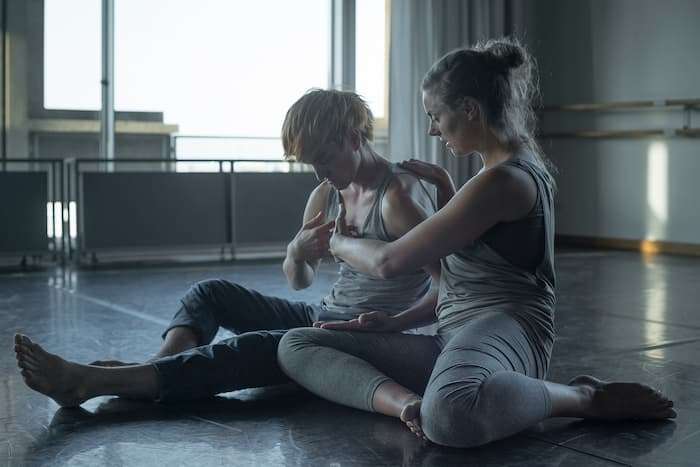
Angelica Mesiti, Relay League (video still), 2017, 3-channel HD video installation © 2026 ProLitteris, Zurich; Courtesy the artist
What role do dance and choreography have in the development of Angelica’s works ?
Dance is, in many ways, a constant presence in her work, though it manifests more explicitly in some pieces than in others. In A Hundred Years, for instance, it is less immediately visible. The work culminates with the appearance of a single performer, a musician playing a requiem on the flute, where movement is more restrained, almost internalised.
In most of her other works, however, the body and its movement play a central role, albeit not always through formal choreography. What emerges instead is a broader understanding of gesture and embodied expression.
Dance, after all, is a fundamental aspect of human culture, present across time and geographies. It has long served as a powerful means of expression, but also as a vehicle for transmitting knowledge, memory, and cultural heritage. In Angelica Mesiti’s work, this dimension is particularly compelling.
How do social rituals, such as agricultural practices and myths, feature in her research, particularly in relation to the sun and the seasons ?
Rituals involving dance are often closely connected to the cycle of the year and to shared collective experiences—whether through dancing around a fire during harvest time or on the occasion of winter or summer solstices, as reflected in The Rites of When. This dimension is particularly important in her work.
Many of these rituals have deep historical roots and continue to be performed today, in one form or another.
How do collaborations with musicians come about ?
It is always a process of collaboration and exchange, particularly in works such as The Rites of When, which involved the French vocal ensemble La Mòssa and DJ Chloé Thévenin.
She consistently allows a great deal of artistic freedom to her collaborators. For instance, in A Hundred Years, which features a musician playing the tin whistle, the focus was on finding someone capable of performing on this specific instrument, rather than prescribing a fixed interpretation.
She also draws on an extensive professional network, both in France and Australia, which enables her to connect with musicians and artists she wishes to collaborate with.
How important is the inclusion of female artists in your curatorial approach ?
The presence of female artists is indeed an important consideration. We are working in a museum dedicated to a single male artist, which naturally forms the starting point of our context. However, Jean Tinguely was active across a wide range of themes and disciplines, which makes it possible and meaningful to bring in contemporary artists whose practices resonate with his methods, concerns, or ways of working.
At the same time, there is a clear intention to ensure a stronger presence of female artists within the museum programme. The next exhibition, Labouring Bodies, curated by my colleague Sandra Reimann, is a good example of this direction and promises to be a particularly interesting project in that regard.
How important is the inclusion of female artists in your curatorial approach ?
The presence of female artists is indeed an important consideration. We are working in a museum dedicated to a single male artist, which naturally forms the starting point of our context. However, Jean Tinguely was active across a wide range of themes and disciplines, which makes it possible and meaningful to bring in contemporary artists whose practices resonate with his methods, concerns, or ways of working.
At the same time, there is a clear intention to ensure a stronger presence of female artists within the museum programme. The next exhibition, Labouring Bodies, curated by my colleague Sandra Herrmann, is a good example of this direction and promises to be a particularly interesting project in that regard.
Which female artists do you particularly admire?
I have always admired artists who engage with different dimensions in their work, particularly those that explore underlying social or political questions.
For example, I greatly admire French female artists such as Sophie Calle, Laure Prouvost, and Camille Henrot.
Where is Museum Tinguely’s audience coming from ?
Our visitors come mainly from Switzerland, Germany, and France, our closest neighbouring countries. Some of them are not familiar with the contemporary artists whose work we present in temporary exhibitions and do not necessarily visit specifically for that reason. For us, this is actually a positive aspect, as it allows us to reach a broader and more diverse audience.
What is your next project ?
At the moment, I am not working on a traditional exhibition, but rather on a low-budget format designed to make Jean Tinguely’s work more accessible. We often receive loan requests from institutions that may not have significant financial resources, so we are currently exploring ways to respond to this need.
The idea is to develop more flexible, cost-effective formats, almost like ready-made “packages” that could be sent to different venues. This would allow us to offer a more accessible way of presenting Tinguely’s work internationally.
When did you decide to become a curator? Was it an obvious choice for you?
No, it was not obvious to me from the beginning. When I first started my studies, I actually wanted to work in theatre as a dramaturg.
During my studies, however, my interests gradually shifted towards the visual arts, and I began doing internships in museums. I later pursued a master’s degree at the École du Louvre, within a Franco-German programme: one year in Paris and one year in Heidelberg. The year in Paris focused on museology and the different aspects of museum work.
Over time, it became increasingly clear to me that I wanted to work in a museum, particularly within a curatorial department. What attracted me was the diversity of the role: the combination of research-based, scientific work and more practical responsibilities, as well as the close interaction with artists and audiences through mediation.
What is the art scene in Basel like beyond the fair?
Before coming to Basel, I imagined it as a much larger city. Of course, in Switzerland everything feels somewhat more compact than in Germany or France, but for its size, the cultural offer here is extremely rich and diverse.
Basel has an impressive concentration of museums, around 40 in total. Among the most prominent are the Kunstmuseum Basel, the Fondation Beyeler, the Kunsthalle Basel, the Kunsthaus Baselland, and the House of Electronic Arts Basel.
I really enjoy this environment and the opportunity to connect with people across these different institutions. At the same time, there is a strong network of independent and artist-run spaces that contribute to a very dynamic off-scene.
In terms of education, Basel is also an important centre, with institutions such as the Basel Academy of Art and Designand the Institute Art Gender Nature, directed by curator Chus Martínez.
Finally, initiatives such as Atelier Mondial play an important role in bringing together artists from all over the world, further reinforcing Basel’s international character.
So beyond the fair itself, Basel is not just a host city for the art market, it is a place where contemporary art is actively produced, shown, and discussed throughout the year.
What decisive encounters influenced your career choice?
My family background has been important in shaping my path, particularly as my grandfather was an artist.
One woman who played a key role in my development ran a theatre group in Heidelberg, where I grew up. Beata Anna Schmutz is now working at the theatre in Mannheim. She was very influential to me, as she is also an art historian. Through her, I was introduced not only to art history, but also to the history of theatre and more contemporary, experimental approaches to performance.
I am still involved in this collective, Rampig, in Mannheim today. That experience was formative, as it encouraged me to remain open to different forms of artistic expression.
This influence is still very present in my life, especially as many people around me now work in the cultural field, whether in theatre, music, or other artistic disciplines.
Practical Infos :
Angelica Mesiti
Reverb
Until August 30
Carl Cheng: Nature Never Loses
Until May, 10
Nicolas Darrot. Fuzzy Logic
Until March 2027
Next :
Labouring Bodies
June,10- November, 8
Online Tickets
https://www.tinguely.ch/en/information/admission/tickets.html
Museum Tinguely
https://www.tinguely.ch/en/exhibitions/on-view-now-and-upcoming.html